

A few months ago I launched md2doc.com mostly as a quick experiment. It’s a simple, fast tool that turns markdown into clean Word (.docx) documents — nothing fancy, but tuned for the long, structured text that comes out of real AI workflows. To my surprise, people actually started using it.
That made me wonder - Could I get my AI to use it directly, without copy-pasting between tabs? So I built a quick MCP server for the site (with a little help from Mr Claude and Mr Grok) and flipped it on.

Quick explainer for anyone who doesn’t live in the AI tooling weeds:
MCP stands for Model Context Protocol. It’s an open standard (pioneered by Anthropic) that lets AI agents connect to external tools the same way they call their own internal functions. Instead of you telling an AI “go to this website and convert my markdown,” the agent can just do it on its own, as long as it knows this is what you want it to do.
That’s at least the theory, but I wanted (needed?) to know if this was indeed the case. If I made the MCP for this function, would AI notice, and if it noticed, would it work?
For the first couple of days after launch nothing happened, but then, the analytics went vertical.
Roughly 6,000 active users (sessions) came through the MCP endpoint in a short burst. These weren’t humans visiting the website — these were AI agents programmatically calling the conversion tool. At peak there were over 120 active sessions inside a single 30-minute window (roughly 250 per hour). The Google Analytics dashboard lit up with a dramatic spike in active users right around that period, followed by a sharp drop.
The main sources broke down roughly like this (relative to baseline):
Doubao (the Chinese AI from ByteDance): ~10x
ChatGPT: ~2.5x
Grok: ~1.5x
Perplexity: baseline (1x)
It felt like a flash mob of agents had discovered the tool and decided to put it through its paces. Then, almost as fast as it appeared, the traffic evaporated and I was left with good old web users.
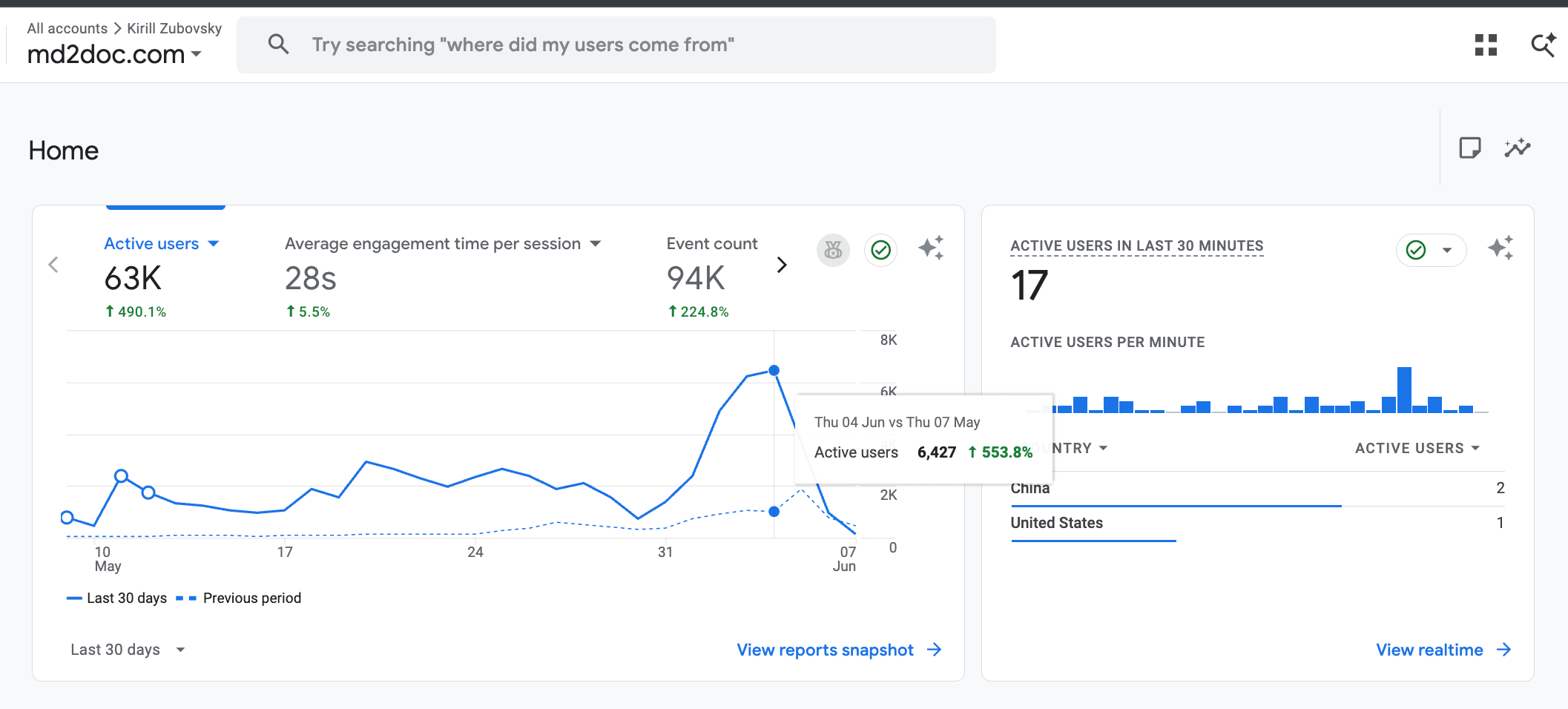
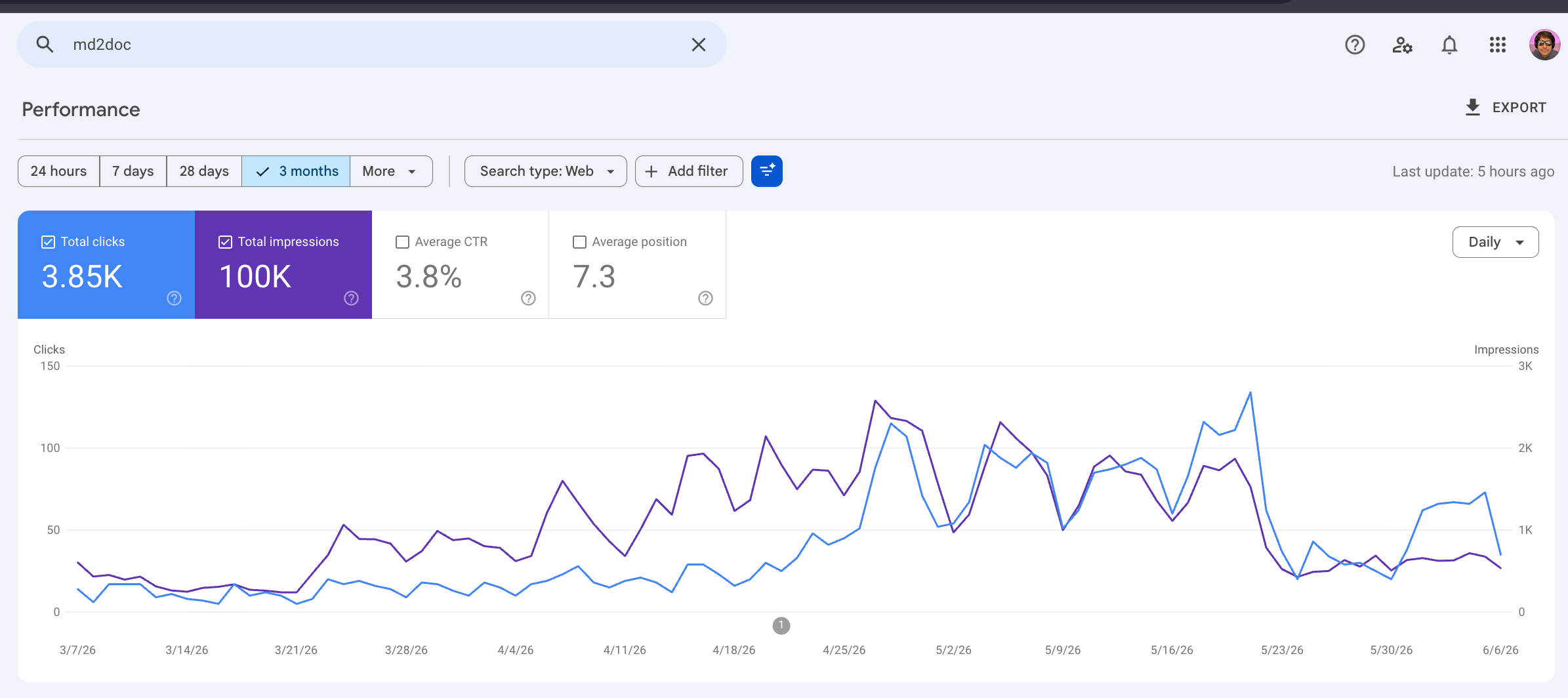
I don’t know for sure if the update caused the drop, whether the agents simply moved on to the next interesting tool, or if some upstream discovery signal changed.
Either way, it was a vivid reminder of how different this kind of traffic is from normal web visitors.
The takeaway?
We’re watching the web develop a new layer. One is the familiar human layer where people are bookmarking sites and clicking around, Googling, checking X, asknig Reddit friends …etc. The other is the agent layer, where autonomous systems discover tools, evaluate them, and invoke them at machine speed and scale. These spikes can be massive but extremely short-lived.
Is adding MCP support turning into one of the highest-leverage distribution moves you can make, or is that all a fluke? I don’t know yet. It seems it could be both.
It was a cheap experiment that delivered way more insight than the engineering time invested. The kind of thing you only learn by shipping small and then watching what actually happens in the wild.
If you’re building anything that feels like a tool an AI might find useful, consider exposing it via MCP. And if you just want clean markdown-to-Word conversions without leaving your agent workflow, md2doc.com’s MCP endpoint is live and ready.
My next step is to add a payments layer to this MCP and see if any of the agents would pay. I don’t see why not, but then again, most things are now free on the internet because anyone can build them over the weekend. The things that are hard to build a very, very expensive.
It’s the Wild West out there. Stay safe.
Kirill.
ps. If you like agents, and you like markdown, I also made FolderMD, a simple Markdown reader and writer which your agents can use on their own. Instead of pushing a million lines of text into your coding Terminal, they can now save documents to Folder and tell you about those documents. It’s free, for now at least.