

This post goes out to all the OGs that have been on X since the days of ugly Twitter backgrounds, chronological timeline, fail-whale, and the most rad place on the internet to meet lifelong friends.
Let’s talk about deleting it all.

What? Yeah.
The X Algorithm
X uses machine learning to build your timeline.
It is a lazy but smart robot that decides who sees your posts. It doesn’t count followers or likes in a dumb way. Instead, it constantly guesses: “If I show this person’s new post to people, will they actually like it, reply, repost, or hang out on it?” Or will they ignore it, hit “not interested,” mute, or block?
It turns those guesses into a score using probabilities (P(like), P(reply), etc.). High positive score = shown to way more people in the “For You” feed, including strangers. Low score = buried. This comes straight from the open-source code; you can review the logic yourself.
So if you want the machine to think you are cool, you first have to appear cool. If you want distribution, your content needs to be shareable. People have to want to see it.
Perhaps some of you are already pretty cool. Maybe you have 100k followers, maybe 1M. You say something and the internet comes alive, flooding your feed with responses.
For the rest of us, mere mortals, the typical experience is different. You post something, and a few friends stoll by, leave a comment, or give you a like, but you just don’t get the personal connection you once had. You are neither getting the firehose, nor a small dinner table discussion. It’s more like you’re taking a bus home, and once in a while your friends end up on the same bus, and you share a few stops together. It’s not very eventful.
How do you do, fellow kids?
Every post you’ve ever made is a part of your “permanent report card” that the robot studies. A bunch of old tweets with zero likes, zero replies, or people scrolling past fast teach the robot only one thing: ”This account usually makes stuff nobody cares about.”
Your old posts make you look terribly, terribly not cool to the machine.

The robot doesn’t care if you think you’re clever, it just wants to know that others think that you are. So even when you post something good today, the robot uses your history to predict low engagement and doesn’t show it to many people. Your new post dies quietly, which adds another bad data point, and the problem gets worse over time (negative snowball).
If your friends on X have been on X since it was the early Twitter, the problem compound because if they are not engaging with the app, the machine now thinks that you have a bunch of followers, all of whom find your content unremarkable. Ouch!
I kid you not, my alt account with 27 followers sometimes gets bigger reach than my actual account that I’ve had since 2008.
How do you appear cool on the internet?
Delete Everything. Clean your report card. Your average “quality signal” goes up. The robot starts predicting better things for your future posts. Your content gets more distribution, more engagement, and the trend reverses.
Most tools that help you clean up old tweets work the same way: set a cutoff date, delete everything before it. Simple, brutal, done. They download all your posts, charge you a monthly recurring revenue, train their models on your data, all while hoping that you forget to unsubscribe for a year or two.
That’s a terrible idea.
The algorithm will punish you for deleting content, and you will appear to be a ghost. You will have to rebuild the whole timeline with new content, and even then, your old followers might not be on X anymore, they will not engage, and you will once again fall through the cracks.
Do you have a better idea?
Yes, I do! Remove bad data, and drop the people who aren’t helping to boost your growth; create a positive loop, instead of a negative one. Here’s how it’s done:
Cleaner history → better predictions
Higher-quality audience → stronger early engagement
Higher score → shown to better people → even more good engagement
If you find all the content that doesn’t boost your signal, and remove it, but keep all the goodies, anything that could be used to generate a new, fresh, upbeat image of you, the robot will gradually trust your account more. New posts will get wider distribution by default. Your timeline visibility will grow, instead of slowly fading as bad old data and bad followers drag you down.
It’s not magic or instant, and you shouldn’t mass-delete everything recklessly (keep your best stuff). But strategic pruning of true low-performers and non-engagers fixes the signals the actual algorithm cares about — the predicted positive vs negative actions based on your real history.
How can I cherry-pick my best tweets?
I am glad you asked — Delete Old Posts — offers a smart cleanup. As an engineer would, I couldn’t stand the other solutions, and the fact they would use my data for their model training, so I created one that works quickly, reliably, does not cost a ton, and does not steal your data.
We get your posts via the X API, store it in YOUR browser, review your posts with AI, and give you a subset of stuff that is likely to hurt your account. You can then either delete them all, or go through the list 1-by-1, and choose what to keep.
This is where using a model to score content before deleting it changes the game.
The basic idea: instead of asking “how old is this post?”, you ask “does this post still represent me?” Those are very different questions. A language
model can evaluate a post on dimensions like:
Cringe factor — does this read as embarrassing in hindsight?
Relevance decay — was this time-sensitive content (hot take, live reaction) that has no shelf life?
Evergreen value — does it teach something, make a point that holds up, spark conversation?
Tone — does this match how you communicate now?
You’re essentially building a classifier that separates “aged well” from “aged badly,” and using that to drive deletion rather than a timestamp. The AI isn’t deciding what’s good — you are, by writing the rubric. The model just applies your taste at scale.
Are you fans of Music Band? Do you board?
Drop your stale followers.

The robot tests your post first on your own followers (the “in-network” part of the code). If a big percentage of them are inactive, bots, spam accounts, or people who never engage (or give negative signals), then the test fails. Low engagement rate = low score = the robot stops pushing your post wider.
Having 10,000 half-dead followers is worse than 3,000 real ones who actually interact. The robot learns from the quality of your social graph and engagement history, not just the raw number. Pruning the dead weight raises your engagement rate immediately. Early likes/replies come faster and stronger, the score goes up, and the robot starts recommending you to way more people outside your circle (the out-of-network “Phoenix” similarity search part).
This is why you should also engage with, and seek engagement from your followers. The whole thing is designed to promote a conversation. Talk, or leave, don’t just linger.
Cleaning inactive or low-quality followers boosts engagement rate and visibility because the algorithm stops seeing your content as “uninteresting to the people who should care most”.
Technical fun fact: There’s no official way to drop someone from following your account on X. The API endpoint to do this is only available on the uber expensive Enterprise plan. That’s why I had to create a Chrome extensions that removes your stale followers by pretending to be you, and uses the native X interface to do this.
In Conclusion
Obviously, it’s up to you what you do. The easiest thing is to do nothing and either continue using X in the way you are or just to stop using it at all. The next thing is to create an alternative account that you start using fresh and to see how it goes for you. It’s pretty fun, actually, but if your original account is tied to your name, there is some value in having X presence that is also your permanent account.
Personally, I did a little bit of cleanup in March, and as you can see my engagement that month has gone up for @kirillzubovsky account. May or may not be a correlation.
I just did a massive cleanup this week; in a few weeks, I’ll have new data.
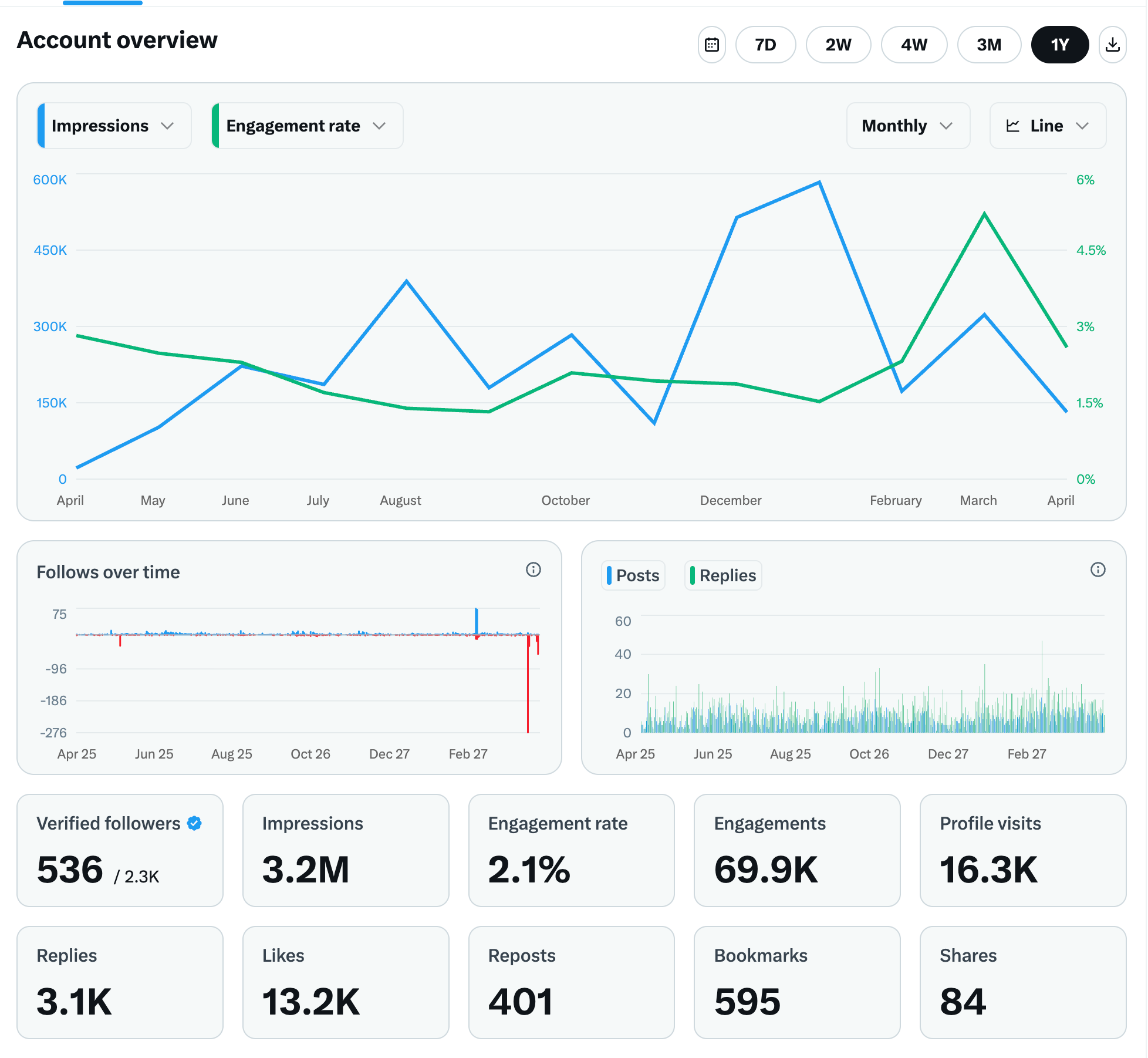
I will keep you posted. In the meantime, if you do end up using deleteoldposts.com and you run into any trouble, let me know and I’ll assist.
Best,
Kirill.