

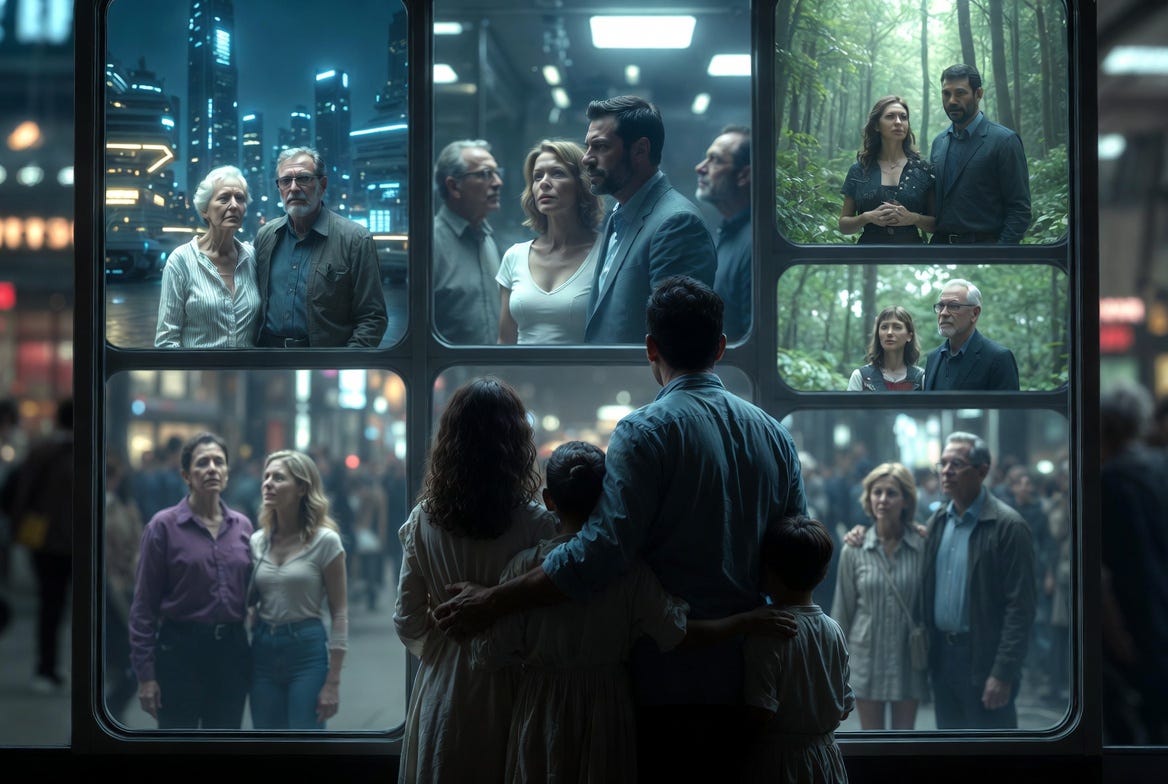
What if memories are not unique, and instead they could be predicted, just like the next token?
It’s a weird question because most of us would like to believe that we are special and therefore our memories are special and unique too. But is that really the case?
Currently, AI chatbots have the ability to create memories about individual users. They store those memories in context and when you make a request for new information, the AIs try to understand if any of existing memories about you are relevant to this conversation. It’s very basic, and it is not infinitely scalable because the more memories they store, the harder it is to give a great response. The AIs work best with the clearest information, and the more you pollute it with other things, the less sure it gets.
What if we could share memories? I don’t mean just between people close to you, but to share memories around the world?
If I’m a dad who lives in Austin and has a dog, then my memories about Austin will also overlap with other families that live in Austin and have a dog. We already share memories in a way, when we do a Google Search. Say I want to find a few fun things to do with the family on a road trip to Houston. I’d find a dozen things to do on the internet, but I will also discard things like bars and nightclubs and prioritize things like the Space Center and the Nature Museum. I’d do that that converge general results around my family’s interests.
Why don’t we just let AI use this information in aggregate?
We could train AI on this shared context and enable it to forecast memories. If my family and I went to the Butterfly Museum and walked from there to the Japanese gardens, there is a chance that 10,000 other families like us did exactly the same thing. Therefore, this is a useful memory to other families like us.
If a car drove over a pothole at a particular GPS coordinate, chances are that thousands of other cars hit that same pothole. We should share that information.
The way we think of memories is something private, something that we don’t want to share though, but we could anonymize this knowledge and train a transformer on what those memories are and how to use them. Your personal data will remain personal, but the transformer will now know how to predict the next token of memory. The best part, this can be done by leverage existing architecture.
By sharing memories, we could literally give AI an ability to see the future.
Your future is just somebody’s past.
p.s. This also answers the question of what happens when LLMs have scraped and trained on all of the content available on the internet. If there’s no way to make money from making content, there won’t be any more training data. Well, your own experience with the machine can now become the data for the machine. From there, it never ends.
p.p.s. So, what are the chances that we are already in the simulation, providing endless data to the machines?